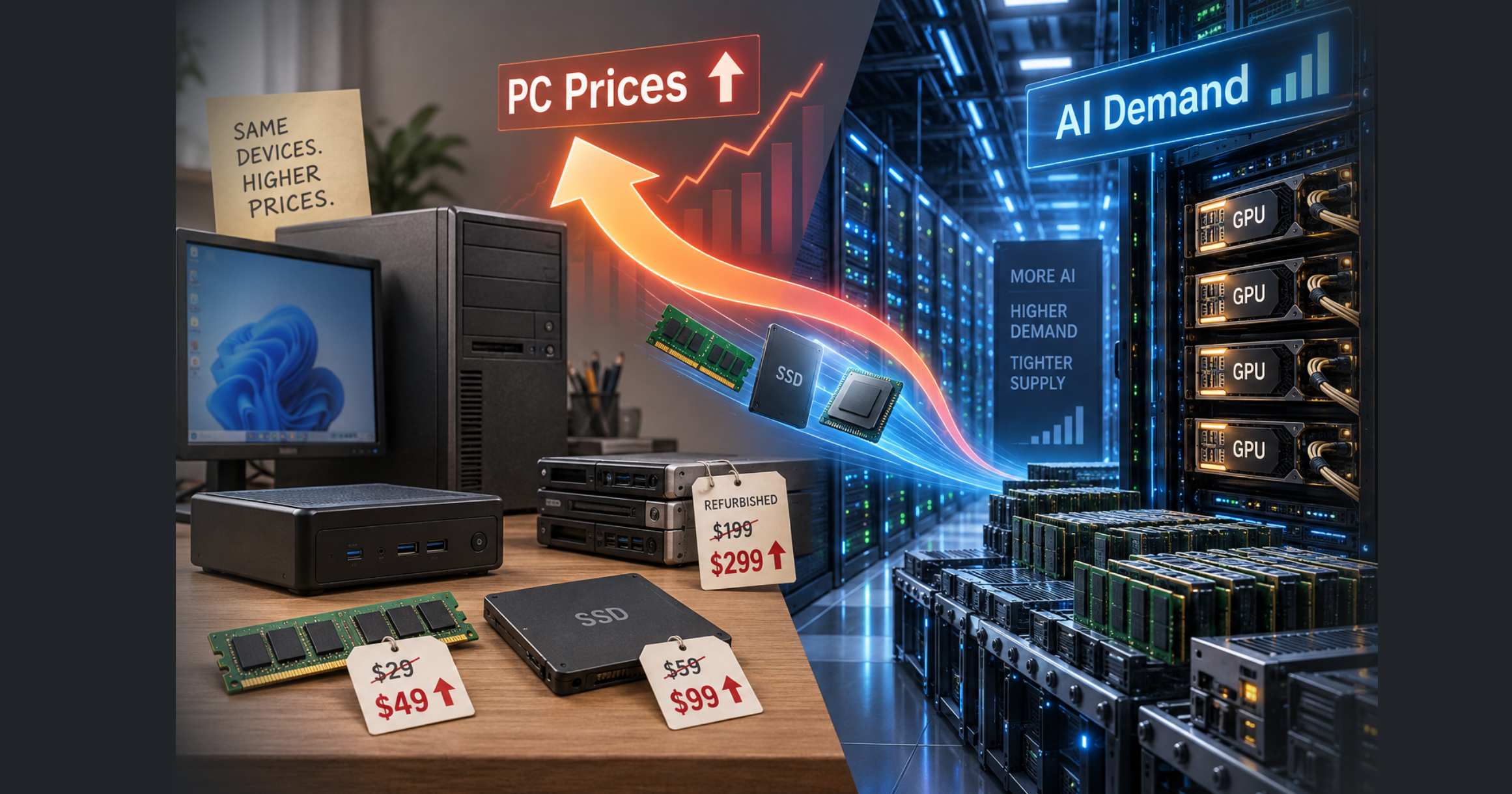
Old office computers, mini PCs, RAM and SSDs are becoming surprisingly expensive.
The reason goes much deeper than ordinary inflation.
A simple search for a cheap computer recently gave me a surprise.
A MeLE mini PC that I had once bought for roughly C$150 was now appearing at several times that price.
At the same time, ordinary refurbished office computers with
8th-generation Intel Core i5 processors—machines that not long ago were commonly available for around
C$150–C$200—were being advertised closer to
C$300–C$400.
Computers are supposed to depreciate. A processor from 2018 has not suddenly become faster.
Its RAM has not become more advanced. Its SSD certainly has not gained capacity while sitting on a shelf.
Yet the prices are real. Looking beyond Canada at the United States, Europe, Russia and China reveals that
the cheap-PC market is being affected by a much larger global hardware problem—and
artificial intelligence infrastructure is one of the major forces behind it.
For years, used corporate computers were one of the best bargains in computing.
Companies would replace thousands of Dell OptiPlex, Lenovo ThinkCentre and HP EliteDesk machines every few years.
Those systems would then enter the refurbishment market in large numbers.
A business desktop that originally cost hundreds—or even more than a thousand dollars—could eventually be purchased for
$150 or $200.
Students bought them. Small businesses bought them. Linux users bought them.
Developers turned them into inexpensive development machines and home servers.
The real question is:
“Why did all the alternatives become so expensive?”
The modern PC industry is experiencing an extraordinary increase in the cost of memory and storage.
Gartner estimates that rising DRAM and SSD costs could push average PC prices approximately
17% higher in 2026 compared with 2025.
That immediately changes the economics of building a cheap computer.
A processor may still be affordable. A motherboard may still look reasonable.
Then you add RAM. Then an SSD. Suddenly the supposedly inexpensive PC is no longer inexpensive.
This is where artificial intelligence enters the story.
Modern AI infrastructure consumes enormous quantities of high-performance memory and storage.
Memory manufacturers naturally want to supply the most profitable segment of the market.
Today, that segment is increasingly the AI data center.
TrendForce has reported that manufacturers have been reallocating production toward
HBM and server products, restricting the amount of capacity available for ordinary PC memory.
But both products depend on finite semiconductor manufacturing, packaging capacity,
investment and production priorities.
This is not simply a Canadian pricing problem.
German hardware-price tracking by 3DCenter found dramatic increases compared with pre-crisis pricing.
| Component | Approximate Increase |
|---|---|
| DDR5 | +386% |
| DDR4 | +226% |
| Laptop SO-DIMM Memory | +271% |
| Internal SSDs | +124% |
A standard 2×16GB DDR5 kit that had previously been around €75 was tracked near €393.
That is not ordinary inflation. It is a significant supply shock.
One might expect PCs and components to remain inexpensive in China because of the country’s enormous electronics manufacturing ecosystem.
But consumers there are facing the same trend.
| Component | Earlier Price | Reported New Price |
|---|---|---|
| 1TB SSD | ¥410 | ¥950 |
| 16GB DDR5 | ¥450 | ¥1,800 |
| 32GB DDR5 Kit | ¥900 | ¥3,800 |
The fact that similar price pressure exists close to the manufacturing supply chain itself
strongly suggests this is a global semiconductor issue rather than merely a Western retail problem.
The Russian market is also experiencing significant price pressure.
Industry reporting indicated that consumer PC memory prices increased roughly
50% to 150% during the first half of 2026.
Some server memory doubled, while certain SSD products increased even more dramatically.
Canada, Germany, Russia and China have very different currencies, taxation systems,
trade policies and distribution networks. Yet the same general hardware trend appears across all of them.
This explains how an old Core i5 office PC can suddenly become expensive.
Suddenly the same old refurbished PC looks attractive at $300.
Gartner has suggested that the traditional entry-level PC market could become increasingly difficult economically
as component costs rise.
This would represent a significant change in personal computing.
For decades, technological progress usually meant that yesterday’s expensive performance eventually became tomorrow’s bargain.
A $1,000 level of performance eventually became $500.
Then perhaps $300.
Eventually something close to it might appear in a $200 machine.
AI infrastructure is disrupting that familiar pattern because some of the same semiconductor manufacturing resources
required for affordable consumer PCs are being directed toward extremely valuable data-center workloads.
No. It would be too simplistic to say that artificial intelligence alone made computers expensive.
Several factors interact:
But AI and data-center expansion are clearly among the important structural forces influencing today’s memory market.
AI promises to make computing more productive.
It helps programmers write software. It helps businesses automate work.
It generates images, analyzes documents, assists scientific research and answers questions almost instantly.
But all of that apparently weightless cloud intelligence has a very physical foundation.
AI may appear on our screens as software, but economically it is also one of the largest hardware construction projects
in the history of computing.
Buyers in 2026 need to rethink some traditional assumptions about computer value.
A refurbished computer can still be an excellent purchase—but
age alone no longer guarantees a bargain.
Most importantly, do not confuse scarcity with technological value.
An Intel Core i5-8500 did not suddenly become a modern CPU because its selling price doubled.
A fivefold increase in RAM prices does not make RAM five times faster.
These are market conditions—not technological improvements.
Perhaps the most interesting part of this story is that the AI revolution is affecting people
who have absolutely no intention of buying AI hardware.
A student looking for a cheap laptop can be affected.
A small business replacing an office PC can be affected.
A developer building a Linux server can be affected.
Someone upgrading an SSD can be affected.
Even someone simply searching online for a small $150 mini PC may suddenly discover
that the inexpensive machine they remember has somehow become a premium product.
It is reaching all the way down to the price tag on an old refurbished PC.
Gartner – Surging memory costs and the global PC market
TrendForce – DRAM and NAND pricing outlook
TrendForce – Memory market supply conditions
3DCenter – German memory and SSD price index
Kommersant – Russian PC memory and SSD market
Reuters – Manufacturers prepare for prolonged memory scarcity
Review project updates, tasks, files, messages, and account details through your private workspace.
Enter your account details to open your project dashboard.
Forgot your password?Need access? Contact your project manager for assistance.